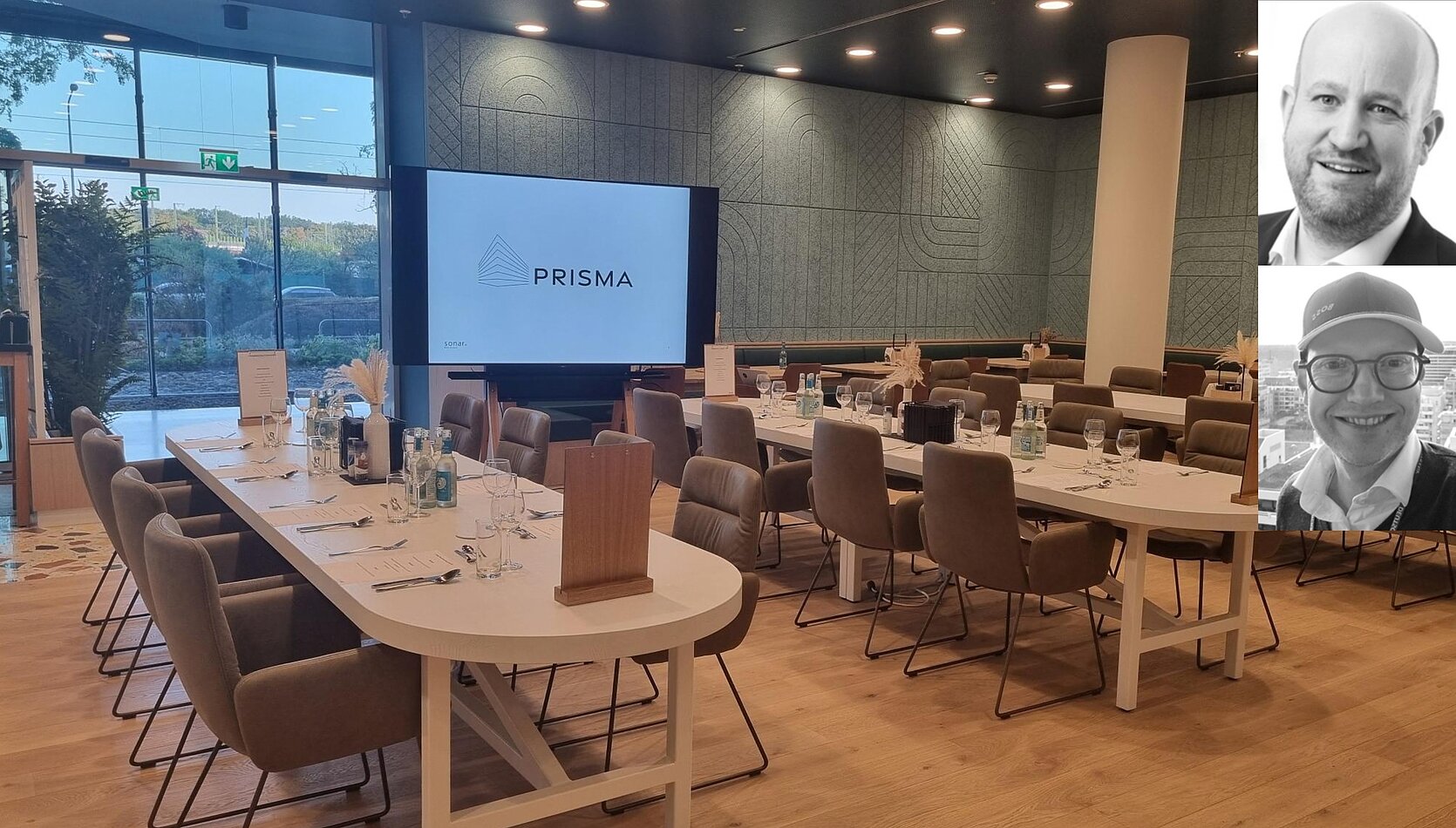
The Lions Club Neues Frankfurt held its latest club evening at the PRISMA on 7 September 2026. To kick off the evening, Holger Hosang, Managing Partner at Sonar Real Estate, introduced the members to the building’s revitalisation and its new concept for how the space is used. He then took the guests on a tour of the PRISMA before the club rounded off the evening with dinner at the restaurant.
In this interview, Dr Dirk Schlatter (pictured above), President of Lions Club Neues Frankfurt since July 2026, and Mike Schulz (pictured below), President from July 2025 to June 2026, share their impressions and explain what they believe an office building needs to offer today.
PRISMA: Dr Schlatter, Mr Schulz, you spent several hours at the PRISMA during your club evening. What was your first impression?
Dirk Schlatter: For me, the visit almost felt like a small homecoming. More than 15 years ago, I spent two and a half years working in the building as an external consultant for DekaBank. So, it was particularly interesting to see how much has changed since then. The interior, in particular, bears very little resemblance to what it used to look like. You can clearly see the intention to transform a traditional office building into a contemporary workplace. The design of the office areas reminds me of the modern workspaces you see at banks or consulting firms today – and I mean that in an entirely positive way. In my view, working in environments like these is considerably more pleasant than in the traditional office settings of the past.
Mike Schulz: I work nearby and, until now, mainly knew the PRISMA from the outside. That made the surprise all the greater when I entered the building. From the outside, you would hardly imagine how spacious and open the atrium is within. Although this is an existing building, much of it feels like a new development. What I find particularly interesting is that the concept does not focus solely on the office spaces themselves, but also on the areas in between. These are places for meeting people, having informal conversations or simply taking a short break. It creates a completely different atmosphere.
PRISMA: Holger Hosang gave you a presentation on the building’s revitalisation before the tour. What stood out to you most from the presentation?
Dirk Schlatter: What impressed me most was how systematically the revitalisation was approached. Before individual measures were developed, there was a very detailed analysis of how the building functions and where its potential lies. I was particularly interested in what can be achieved in terms of energy performance in an existing building using modern building technology. As an outsider, that is something you would not normally get to see that in such detail.
Mike Schulz: I felt the same way. When you think of refurbishment, you might initially think of new flooring, new walls and a more modern design. But this project goes much further than that. The presentation made very clear how much importance is attached to energy efficiency, sustainability and the long-term use of the existing building. That is what makes the revitalisation particularly interesting to me.
PRISMA: There is currently a great deal of discussion about what an office needs to offer in order for people to enjoy coming to work. How important is the quality of the working environment in your view?
Dirk Schlatter: It is an important factor – although, of course, not the only one. When choosing an employer, the nature of the work, career opportunities, remuneration and corporate culture all play important roles. But where and how I spend my working day matters too. The greater prevalence of working from home has changed expectations of office space: if I come into the office, that place needs to offer me added value. An attractive working environment can therefore certainly be a factor that ultimately tips the balance.
Mike Schulz: In my view, a good office also makes people more willing to work on site voluntarily. If I could work from home but find excellent working conditions, my colleagues and a pleasant atmosphere at the office, there are good reasons to come in anyway. That is precisely why the working environment is more important today than it perhaps was a few years ago.
PRISMA: What, for you, makes the difference between simply having a place to work and being somewhere you genuinely enjoy spending more time?
Dirk Schlatter: For me, it is also about things that might initially seem quite small. I find the gym and the changing and shower facilities after exercising or cycling to work very attractive, for example. If you have a long working day and perhaps a lengthy commute as well, it can otherwise be difficult to fit exercise into your daily routine. When facilities like these are available on site, it becomes much easier to combine work with your personal life.
Mike Schulz: The communal areas are another important aspect. With the planned greenery, I can easily imagine the atrium becoming somewhere people sit down after a meeting, read something or talk to colleagues. If the furniture, lighting and atmosphere are right, it creates a quality of space that goes far beyond the traditional workstation. And for me, the food and beverage offering is part of that, too. We were extremely pleased with both the food and the service during our club evening.
PRISMA: Interaction and exchange also play a greater role in modern office concepts. Is that something you experience as well?
Dirk Schlatter: Absolutely. For me, one of the main reasons to come into the office is personal interaction. You meet a colleague for coffee, start talking and eventually find yourselves discussing topics that might never have come up in a scheduled Teams call or an email. That is important for collaboration – quite apart from the human aspect. The key is therefore to create the right mix: open areas for interaction, meeting rooms and, at the same time, places where people can withdraw for focused work or a call.
Mike Schulz: These different ways of using office space are becoming increasingly important. Desk sharing and working from home mean that offices are planned differently today than they were in the past. Not everyone needs the same permanent desk, but there still need to be enough suitable areas for different types of work. Many companies are still in the process of finding the right approach. That makes it all the more helpful when a building offers the flexibility required in the first place.
PRISMA: What role does sustainability play in making an office building attractive?
Dirk Schlatter: I would distinguish between two levels. The first is something you experience directly: natural materials, plants and pleasant design all help people feel comfortable in a building. Then there are the measurable factors, such as energy consumption and CO₂ emissions. These are playing an increasingly important role, particularly for companies and when decisions are made about locations. Their importance may vary from one employee to another, but in my view the issue will continue to gain significance.
Mike Schulz: Sustainability is particularly relevant for companies today, for example when they look at their carbon footprint and pursue related targets. At the same time, awareness of the issue is also increasing across society. That is why I believe the importance of sustainable buildings will continue to grow.
PRISMA: Another factor is the location. How would you rate the PRISMA’s accessibility?
Mike Schulz: The accessibility is very good. That applies both to commuters and to people coming from Frankfurt itself. I find the proximity to the airport particularly interesting – for example, for companies hosting guests for a one-day meeting. From the airport, you can reach PRISMA very quickly without first having to travel across the entire city centre. On top of that, there are good connections to central Frankfurt as well as parking facilities.
Dirk Schlatter: I know the location from when I previously worked here and can confirm that. The building is very easy to reach both by car and by S-Bahn.
PRISMA: What is your overall impression of your club evening at the PRISMA?
Dirk Schlatter: The format worked very well for us. After the presentation and the tour, we were able to move on to our actual club evening in the restaurant and discuss our internal topics. That gave us both an interesting insight into the building and, afterwards, enough space for discussions within the club. And the culinary experience clearly exceeded our expectations as well.
Mike Schulz: I can only agree. The presentation was informative and engaging, the tour gave us a very good impression of the building, and the food was excellent. The service was also very attentive. Overall, it was a highly successful evening for us.
PRISMA: Finally, if a company is currently looking for new office space in Frankfurt, why should it take a closer look at the PRISMA?
Dirk Schlatter: Because, in my view, the PRISMA brings together the key requirements of a modern office building: good accessibility, contemporary working environments, amenities that go beyond the workplace itself, and a well-conceived sustainability concept. Of course, you can always find a standout feature in individual buildings – but what ultimately matters is the overall package. And I find the overall package at the PRISMA very compelling.
Mike Schulz: There is an interesting combination here of an existing building and the quality you would associate with a new development. The building itself may not be new, but the comprehensive revitalisation means that tenants can move into spaces that feel brand new yet can still be tailored very individually to their own requirements. Add to that are the accessibility, the parking facilities and the additional amenities within the building. In my view, anyone currently looking for office space in Frankfurt should definitely take a look at the PRISMA.
PRISMA: Mr Schulz, Dr Schlatter, thank you very much for speaking with us.